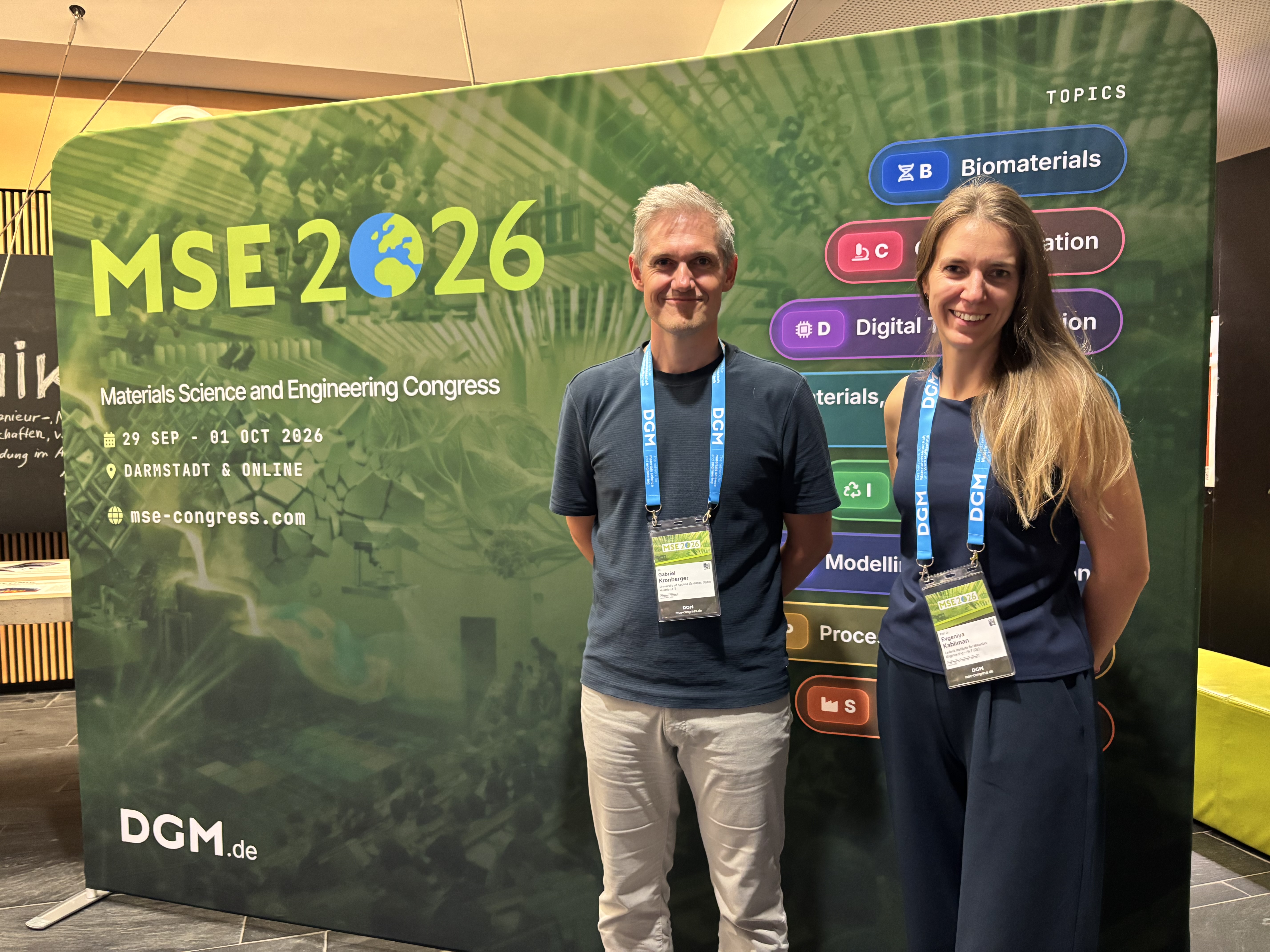
MSE Congress: Minisymposium on Symbolic Regression for Materials Science and Engineering
Post by Gabriel Kronberger
The Minisymposium for Symbolic Regression for Materials Science and Engineering took place as a part of the Materials Science and Engineering Congress on the 29th of September 2026 in Darmstadt, Germany.
The main topics were applications of symbolic regression for prediction of structure and mechanical properties of materials and crack tip location prediction. Several talks mentioned the need for handling uncertainty in data and models and using it for principled model selection to resolve overfitting in SR. Integration of physical constraints (e.g. unit-aware SR) was also mentioned by several speakers. SR implementations used: PySR (most popular), Φ-SO (convenient for physical units), and NeoGP (DL-aware model selection). SR was used with real data and data from simulations.
The Materials Science and Engineering Congress takes place every other year at Technical University Darmstadt and can be considered one of the most important scientific events for materials science in Europe. It is organized by the German Association for Material Science (DGM - Deutsche Gesellschaft für Materialkunde) and is held as a hybrid event. The location is easy to reach from Frankfurt Airport via a direct bus connection which drops you off almost in front of the event location within 30 minutes.
We are happy with the number of participants; around 20 - 30 participants in the session. This is comparable to the participation at ECCOMAS/WCCM and similar to the GECCO 2025 Workshop in Malaga.
From this year's minisymposia at ECCOMAS/WCCM and at MSE Congress, I have the feeling that symbolic regression / equation discovery is interesting to researchers in Materials Science because of its potential to find interpretable formulas. However, I think the methods and implementations are still lacking and not (yet?) able to deliver this promise.
What is missing? I believe there are several pieces. One of my favorite topics the previous two years is principled handling of data and model uncertainty (Bayesian inference) and its integration into model selection, e.g. based on minimum description length as one approximation of the Bayesian evidence. The techniques are known, but they are not implemented or supported by symbolic regression implementations. Additionally, uncertainty information for data must also be provided on both sides. SR tools and applications must improve in this direction. The talks by Evgeniya Kabliman (IWT, SR as a new pathway for automated discovery of material laws) and Manfred Mücke (MCL, Equayes - Post-hoc Inference over Analytic Expressions) mentioned explicitly the need for handling uncertainty. I also showed an example where we used genetic programming for symbolic regression with MDL selection to automatically select models of optimal complexity for predicting e.g. yield strength as a function of heat-treatment duration and temperature. No cross-validation, no hyperparameter tuning, no overfitting!
Another missing piece is connecting known physics and constraints with the data-driven "curve-fitting" of SR -- we could call this grounding of SR in existing theory. Several techniques have been proposed (e.g. unit-aware SR, shape-constraints, physics-inspired SR), but I think there is still something left on the table. We do not yet have a reliable, general, and easy to use tool available. In the minisymposium David Melching and Florian Paysan (both DLR) presented their work where they used unit-aware SR as implemented in Φ-SO for finding a short SR model for crack tip shielding effects. I believe that LLMs could provide the link between physical theory in the form of papers, existing formulas, and textual descriptions of expected convergence behaviour or function shapes and statistical / empirical function fitting. In this vein, I briefly presented the idea of using AI agents in an evolutionary loop to improve a large physics-based (mean dislocation density) numerical model. In this ongoing work together with Johannes Kronsteiner and Sindre Hoven (both LKR), we are trying to improve the parts relevant for recrystallization processes, so that it better matches observations.
Thank you to all the speakers for the well-prepared talks and for the insightful discussions.
Program
Symbolic regression as a new pathway for automated discovery of material laws,
Kabliman, E. (Speaker); Sikder, N.,
Leibniz Institute for Materials Engineering - IWT, Bremen (DE)
Sets the stage by highlighting how symbolic regression provides unique capabilities to derive interpretable constitutive laws linking microstructural features to mechanical properties.
Equayes - A tool for post-hoc inference over analytic expressions,
Mücke, M. (Speaker); Findenig, C.,
Materials Center Leoben Forschung GmbH (AT)
Presents Equayes, a tool for Bayesian inference to assess candidate expressions.
Prediction of Mechanical Properties of Heat-treated EN AW-6082 using Symbolic Regression,
Kronberger, G. (Speaker); Raaber, S.; Grohmann, L.; Pichlmann, L.; Kronsteiner, J.; Österreicher, J.A.,
University of Applied Sciences Upper Austria, Hagenberg (AT);
AIT Austrian Institute of Technology, Vienna (AT);
LKR Light Metals Technologies, AIT Austrian Institute of Technology, Ranshofen (AT)
Uses genetic programming to derive short, accurate symbolic regression models predicting four tensile properties of heat-treated EN AW-6082 aluminum as a function of tempering temperature and duration, with the best model selected via minimum description length. The resulting models require no cross-validation or hyperparameter tuning and allow to calculate prediction uncertainty.
Slides (PDF)
Symbolic Regression-Based Estimation of Crack Tip Shielding Effects due to Secondary Branching,
Paysan, F. (Speaker); Breitbarth, E.,
German Aerospace Center (DLR), Köln (DE)
Derives an analytical symbolic regression formula linking secondary crack branching geometry (branching angle, secondary crack length) to the reduction in crack driving force of the primary crack.
From Symbolic Regression to Reliable Crack Tip Annotation in Full-Field Digital Image Correlation Data,
Melching, D. (Speaker); Dömling, F.; Paysan, F.; Strohmann, T.; Schultheis, E.; Dietrich, E.; Breitbarth, E.,
German Aerospace Center (DLR), Köln (DE)
Uses physics-guided, unit-aware symbolic regression on simulated displacement fields to derive closed-form crack tip correction formulas expressed via Williams-series coefficients.
Extending a Physics-based Recrystallization Model using Genetic Programming,
Kronberger, G. (Speaker); Kronsteiner, J.; Raaber, S.,
University of Applied Sciences Upper Austria, Hagenberg (AT);
LKR Light Metals Technologies, Austrian Institute of Technology, Vienna (AT)
Discusses a genetic programming approach to extend a physics-based numerical model to improve the representation of recrystallization processes.
Slides (PDF)